

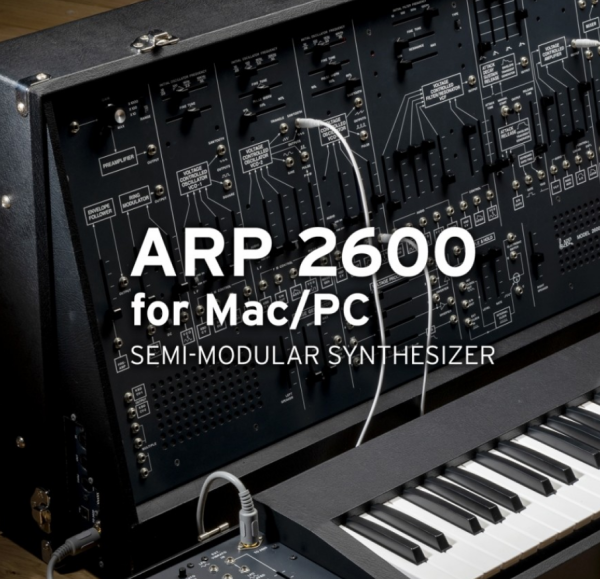
🎹 唯一且无可替代的 ARP 2600。 这款标志性的合成器,是你在每个顶级录音棚都能预期见到的身影。它在二手市场的价格高不可攀。当 KORG 在 2020 年发布限量版 ARP 2600 FS 时,全球立即售罄。如今,KORG 荣幸地推出这款必备合成器的首个真正精确的软件复刻:KORG Collection ARP 2600。
🛠️ 精确至细节的建模
KORG 专有的 CMT 技术 忠实地复现了其独特的波形与滤波器、定制的低频振荡器与包络形态、诸多细微的非线性特性,甚至是跳线面板的行为——这是其他任何 2600 软件乐器都无法比拟的。得益于这种对细节的执着追求,你可以打开原始的 ARP 2600 音色手册(可在 KORG 官网免费获取 PDF),在屏幕上逐一连接手册中的 100 个预设,它们听起来将与正宗的 ARP 2600 毫无二致——这是其他 2600 插件都无法做到的。
✨ 将 2600 带入现代
保留原版卓越的音质、惊人的灵活性和独特的个性只是一个开始。为了真正致敬这款传奇乐器的遗产,我们扪心自问:如果 ARP 在今天重新设计 2600,它会是什么样子?为此,我们进行了诸多改进,包括增加第二个滤波器、一个驱动模块、新的调制源、广泛的 MIDI 控制、一个复杂的音序器,以及最多 16 复音等等——同时始终保留原始 ARP 2600 设计的精神。
🔍 细节之美
我们的工程师投入大量时间研究原始和现代电路图的每一个细节,仔细研读原始的 2600 手册,用示波器测试,而最重要的是用耳朵聆听。例如,原始的 AR 和 ADSR 包络 可能看似简单,但花费了大量时间和调整才使它们准确无误。振荡器波形是精确的,包括那些增添独特亮度(尤其是三角波和正弦波)的细微不完美。我们对两个原始的 VCF 模块(4012 和 4072)都进行了建模,并可通过开关在两者间选择。我们包含了原始硬件上所有的饱和点,以及为声音注入生机的微妙失真。遍布各个模块的先进抗混叠技术让我们能够提供真正卓越的音频品质。KORG 的组件建模技术 包含了模拟元件间的差异,就像你在多台硬件 2600 上会发现的那样,从而在演奏复音时带来自然的丰富性。
在跳线面板之外,还有20多个微调电位器,用于选择不同年代 2600 的行为模式,精确校准方波宽度、三角波对称性等细节(就像原版硬件一样)。
🎛️ 保留并拓展 2600 的精神
比起大多数复古合成器,2600 更拥有其独特的个性。首先,各个部分都不相同;每个部分都有其自身(通常不止一个)的用途和匹配的能力。三个VCO各有不同特点。两个包络器的工作方式大相径庭。它有许多隐藏的特性,例如看似相同的控制输入却有不同的范围、相位反转以及不寻常的波形。这是一件精心设计的乐器,但也感觉像一套定制模块的集合。这些差异引导着你的视线,也简单地为探索带来了乐趣。总有一种“哇,我也能让它做到这个!”的不断发现之感。
在添加所有新功能时,我们决心保留原始乐器的精神。因此,我们抵制住了将其统一和标准化的现代冲动。每个 VCO 仍然各不相同。当我们添加一个新的包络和一个新的 LFO 时,我们确保它们与原始的不同,从而创造新的声音,而不仅仅是“更多”。当我们添加第二个滤波器时,我们使其与主 VCF 完全不同。每个新功能都有其独特的声音。所有新增功能都有合理的默认连接,整合了新的 LFO、包络和音序器。
我们也保留了原始乐器的所有控制,即使增加了这么多新功能,我们仍保留了基本布局。如果你熟悉旧的 2600,或 KORG 新的 2600 FS 和 2600 M,你会感到非常亲切——但同时拥有了更多可玩性。
The one and only ARP 2600. The iconic ARP 2600. It’s the one synth you can expect to see in every major studio. They demand astronomical prices on the second hand market. When KORG released the limited- edition ARP 2600 FS in 2020, they sold out immediately world-wide. Now, KORG is pleased to present the first truly accurate software re-creation of this essential synthesizer: the KORG Collection ARP 2600.
KORG’s proprietary CMT technology faithfully reproduces the distinctive waveforms and filters, the custom LFO and envelope shapes, the many subtle nonlinearities, even the behavior of the patch panel – unlike any other 2600 software instrument. Thanks to this obsessive attention to detail, you can open the original ARP 2600 Patch Book (available as a free PDF on KORG’s website), hook up each of the 100 patches on screen, and they will sound just like an authentic ARP 2600 – something that no other 2600 plug-in can do.
Bringing the 2600 into the modern age
Preserving the fantastic sound quality, incredible flexibility, and quirky attitude of the original was only the beginning. To truly honor the legacy of this legendary instrument, we asked ourselves: if ARP redesigned the 2600 today, what would it be like? In response we made many improvements, including adding a second filter, a drive section, new modulation sources, extensive MIDI control, a sophisticated sequencer, up to 16-voice polyphony, and much more – all while keeping the spirit of the original ARP 2600 design.
Beauty in the details
Our engineers spent considerable time understanding every detail of the original and modern schematics, poring over the original 2600 manuals, testing with oscilloscopes, and most importantly listening.The original AR and ADSR envelopes, for example, might seem simple – but it took a lot of time and tweaking to get them just right. The oscillator waveforms are correct, including the slight imperfections that add a unique brightness (especially for the triangle and sine). We modeled both of the original VCF modules, the 4012 and the 4072, with a switch to select between them. We included all of the many saturation points on the original hardware, with subtle distortions that bring life to the sound. Extensive anti-aliasing techniques spread throughout the different modules let us deliver truly premium audio quality. KORG’s Component Modeling Technology (CMT) includes variations between analog components, just as you’d find with multiple hardware 2600s, to deliver natural richness when playing polyphonically.
Outside the patch panel, there are 20-odd Trim Pots to select between behaviors of different 2600 vintages, dial in calibration details such as square wave width and triangle wave symmetry (just like the original hardware), and more.
Preserving and expanding the 2600 spirit
Even more than most vintage synths, the 2600 has a character all its own. To begin with, no two sections are alike; each has its own purpose (often more than one) and capabilities to match. Each of the three VCOs has different features.The two envelopes work very differently. There are many hidden quirks, such as different ranges for identical-looking control inputs, phase inversions, and unusual waveforms. It’s a carefully considered instrument, but it also feels like a collection of bespoke modules. The differences guide the eye, and also simply make it fun to play around with. There’s a constant sense of discovery, of “wow, I can make it do that, too!”
When adding all of the new capabilities, we were determined to preserve the spirit of the original instrument. So, we resisted the modern urge to unify and standardize. Each of the VCOs is still different. When we added an envelope and an LFO, we made sure that they were different from the originals, enabling new sounds instead of just “more.” When we added a second filter, we made it entirely different from the main VCF. Each new feature speaks with its own voice. All of the additions have sensible normalled connections, incorporating the new LFO, envelope, and sequencer.
We also kept all of the controls of the original instrument, and even with all of the additions, we preserved the basic layout. If you’re familiar with the old 2600, or KORG’s new 2600 FS and 2600 M, you’ll feel right at home – but with even more to play with.
home page
https://korg.shop/software/korg-collection-series/single-products/korg-collection-arp-2600.html